For me this weekend there was a collision of events — the 4-car pile-up kind — that screamed "You are OLD!" The premiere event being my 25-Year High School Reunion on Saturday night. It was exciting to see faces I haven't seen in years. It was also a sobering reminder about the lifestage I'm in.
- The day before the event, I spoke with a friend my age who confessed he was in the middle of getting his colonoscopy/endoscopy.
- At the event, I sat next to a married couple who just became grandparents.
- While sitting next to these grandparents, a buddy texted me who’s both younger than me and about to become a grandparent.
It felt like a lot of signals. Each flashing O-L-D.
And then the next morning I saw this tweet:
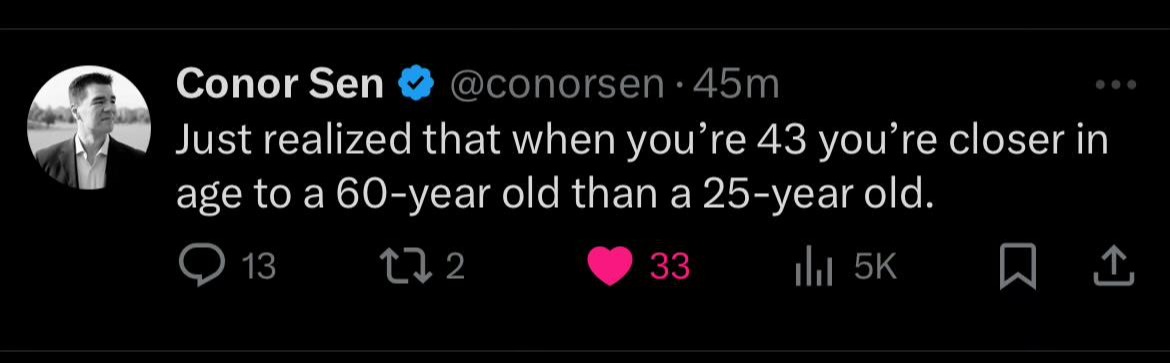
Walloped over the head I tell you. Lord have mercy: I got the message!
The other funny thing about reunions is the anxiety. The anxiety of someone who knew the young version of “you” seeing you, hearing about your life, and forming judgments about the choices you have made. This is enough to keep people away from reunions entirely. Or motivate people to lose the 15 lbs. that they’ve wanted to shed, or otherwise embellish in order to present the best possible version of themselves to others.
It’s as if showing up means standing up against a great, big yardstick and being measured.
And what would it mean if we’ve been measured and found wanting?
That whole song and dance reminded me of words recently published by Morgan Housel :
People become so nervous about what other people think of their lifestyle and investing decisions that they end up doing two things: performing for others, and copying a strategy that might work for someone else but isn’t right for you.
I try to keep in mind that there are two ways to use money. One is as a tool to live a better life. The other is as a yardstick of success to measure yourself against other people. The first is quiet and personal, the second is loud and performative. It’s so obvious which leads to a happier life.
A tool? Or a yardstick?
High school reunions are one of the special ways that we can be reminded that no matter how far we’ve come, we never truly outgrow caring what our friends think about us.
Money also can be this way. If we’re not careful, we can be carried away into playing some game with investing that we have no business playing — and for silly reasons.
Warren Buffett has an artful way of thinking about this:
Would you rather be the world’s greatest lover, but have everyone think you’re the world’s worst lover?
Or would you rather be the world’s worst lover but have everyone think you’re the world’s greatest lover?Now, that’s an interesting question. Here’s another one. If the world couldn’t see your results, would you rather be thought of as the world’s greatest investor but in reality have the world’s worst record? Or be thought of as the world’s worst investor when you were actually the best?
Mr. Buffett goes on to advocate for caring more about your inner scorecard . That’s not to say that we shouldn’t care at all about our reputation. Of course we will. But an even higher and more important standard is the one to which we hold ourselves.
The ways this applies to our money are manifold, but I’ll pick one. If having more money is the goal, it will never be enough. Scott Galloway says it this way in his new book, The Algebra of Wealth:
Money is the ink in your pen, but it’s not your story. It can write new chapters and make some brighter, but the narrative arc is up to you.
So how do we measure our lives? That’s beyond the scope of our work here.
But in terms of financial advice: if you haven’t yet done the work to define for yourself what’s a life well-lived, your financial advisor can only take you so far. (I think we can tell it’s made up of much more than our own bottom line.)
And I can say this with full conviction: if you know your values, are practicing your values, and have a good idea of your desired future outcome, you’re ahead of 80% of the field. And with that kind of sober-minded sense of direction and good financial habits, your financial advisor is going to help you go even further.